Curling FAQs
1) Do I need to know how to skate to participate in curling?
Absolutely not. Curling is played wearing shoes, not skates. You do have to be careful, however, as ice can be slippery.
2) Is curling an individual or a team sport?
Curling is a team sport. Each team consists of 4 players on the ice. When you play, your team plays against one other team (e.g. a game consists of two teams).
3) How many games can be played on the ice at one time?
In curling, the playing surface is called a “sheet”. We will have 3 sheets so 3 games can occur at one time. With three games there would be a total of 6 teams on the ice at one time.
4) I’ve heard the term curling “rocks” or “stones”. Is curling played with rocks?
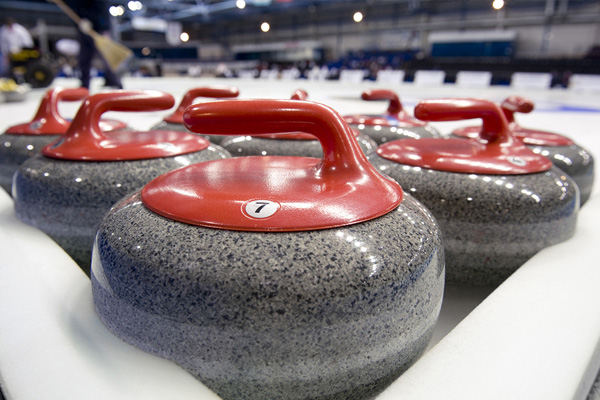
Yes and no. Curling stones are made out of granite, which is where the term “rocks” and “stones” come from. However, these “rocks” are somewhat flat on the top and bottom, and round in shape, and are made with quite a bit of precision. These “stones” also have built-in handles. You can see curling rocks on our website in pictures and the video (also see the top of this page).
5) Curling sounds like a physical sport, can anybody curl?
Curling sounds physical as we typically think of “curling” as a weight lifting exercise. However, the sport of curling is a strategic game. Sliding the rocks (called throwing, though you never lift a curling rock off the ice) isn’t difficult as the rocks are gliding across the surface of the ice. Controlling the rock is what is important. You don’t want to “throw” the rock too far or have it come-up short. You also learn how to make the rock “curl” (hence the name curling), so that the rock moves left-to-right/right-to-left as well as forward. That being said, curling can provide good exercise. “Sweeping” (scrubbing the ice with your curling broom which reduces friction, allowing the rock to go farther) can take some effort—think scrubbing a stain off the floor of your garage with a push broom. While sweeping, you are also walking—think scrubbing that stain with your push broom if the stain was 30’, 50’, maybe even 75’ long.
6) If I want to play in a league, but am not part of a team, can I still play?
Definitely. The way we will structure the leagues is: the individuals who want to form their own teams can form their own teams. The individuals, who aren’t in a group that wants to form a team, will be assigned to a team. We will make sure that teams aren’t “stacked” with exceptional players, which shouldn’t be difficult since almost nobody in the Mid-South has ever curled.
7) What if my team and I really get into this and want to play in some competitions?
Once we get going, we will be registered with the United States Curling Association (USCA) and will belong to a specific USCA Region. Tournaments (called Bonspiels) are often held within a particular region. There are also “open” Bonspiels, where you don’t have to belong to a specific region. Some of these Bonspiels are geared toward less-advanced players or have divisions dedicated to less-advanced players (for instance a “5-and-under” Bonspiel would be for teams whose players all had 5 years or less experience in curling).
8) What if I’m not interested in competing… I just want to have fun?
Curling is a fun sport. It also has a big social component. Typically after a game, the teams get together in the lobby to socialize. Our concession stand will be open, offering food and soda, as well as beer and wine coolers, after the games. Curling is a great sport for people who just want to play a fun game and socialize… it is also a great sport for those who are competitive and want to advance into competitive play. As we grow, we will likely structure the leagues so that the more serious, competitive teams will play together, and the “just for fun” teams will play together. However, the social component in curling never disappears, no matter how serious and competitive the teams might be.